Showing posts with label Review. Show all posts

Tuesday, July 29, 2014

July Blind Spot: Jalsaghar(The Music Room)

Couple of years ago when I was doing my Masters in US, one of my university friends was kind enough to lend me his copy of Apu trilogy. This was my first and so far only excursion into cinematic world of Satyajit Ray, probably the only Indian director with a worldwide fame and following. Considering how successful that experiment went, (it certainly was a success, so much so that Pather Panchali(1955) sits prettily in my personal ‘Top 100’) it is rather sad that I never saw any of his other films since. So I put one of his films on this year’s blind spot list, since that is what this list is for – to get rid of such blemishes.

Even though it is directed by Satyajit Ray, considering this is a Bengali film, this film also provides me a unique opportunity. Usually films I choose for this list are those which are supposed to have been seen my most people. So I try not to get into plot details and other usual suspects of review. But I would be very surprised if many of those who frequent this place would have seen this movie. So, for a change, I get to frame this post as a traditional review.

Jalsaghar(1958) or The Music Room, as it is known internationally, is a story of Biswambhar Roy, a last of his kind landlord which means he is basically a royalty in areas surrounding vast pieces of lands he owns. It also used to mean that everyone leaving in that area would depend on him for their livelihood but his estate is in dilapidated state. He has inherited lands that are being depleted by river nearby and there is not much he can do about it. So he has the title and even respect of the people that comes with it but no perquisites that usually follow.

But his status in the community means he has to live pompous life his ancestors did, even if it is only to put up a show for others and pinnacle of his ostentation is his music room. His music room is where he would invite some of the best artists - singers, dancers, musicians - to put up a show for him and would invite most important people around to accompany him. Even being a part of this group would mean your entry in landlord's innermost circle and indication of your elevated social status.

Only problem here, however, is Biswambhar Roy's estate is running on fumes and can not really afford all this extravagance. He even has to sell family jewels of Roy family that have been passed on for generations to pay for initiation ceremony of his son but even this doesn't deter him from his flamboyance. His wife tries to open his eyes but there is no other way he can live by and in the end, he succumbs to illusion of his grandeur, leaving his his last two remaining servants helpless witnesses of this event. His manager, who handles all his financial business and other things related to his lands, is solemn, worried where this might lead to while his man servant is almost giddy to see his master back to his old ways months after. [SPOILER]What he doesn't realize is this is candle burning brightest before extinguishing[SPOILER END].

Jalsaghar was Satyajit Ray's only third film; he made it between second and third installment of Apu trilogy. But, even though this was obvious right from Pather Panchali, sensibilities of this film are of a seasoned film maker. Premise of changing times and someone who once prospered in it failing to adapt to these times is not exactly novel. But what makes it work despite being the same old story is Satyajit Ray's handling with a knack of seasoned storyteller. He knows what he is going for, how he wants to get there and he does so right on the money.

He highlights hollowness of Roy's lifestyle from very first frame. His idiosyncratic behaviour to keep up with it and cling on to stupid notions of his false status only make him more miserable and Ray does not flinch from showing this. But he doesn't make him spineless which makes it much more interesting character; someone I genuinely cared for despite being rather vain. He is not without his values, however vain they might be and not without his qualities either, however crazy they might be especially under the given circumstances.

Chhabi Biswas, playing protagonist Biswambhar Roy, makes it even more impressive with great range he puts on display here - from someone who is lordly from head to toe, riding his beautiful horse Moti to a hollow shell of that man we see in the very first scene with no idea of time and date. His ease and command with which he slips into persona of Biswambhar Roy also played major role in making me sympathetic towards him, despite all his glaring faults.

While Roy is seeing the last days of his fading glory, Ray makes this story even more contrasting by adding character of Mohit Ganguly, son of userer leaving nearby, and making him a rising star. Roy constantly feels threatened by him as quite possibly he is looking to replace him. There are quite a few confrontational scenes between the two in film and almost every single one of them would find its place on highlight reel. Ganguly, being a self made man still not used to be a part of dignified society around him, is like a new kid on playing ground; always uncomfortable around Roy. And Roy, possibly because he himself not comfortable with his rise, constantly trying to cross him.

And finally, Indian classical music that is featured so richly in this film. I have to admit one thing though - however deplorable this guy might be, he certainly had a good taste in music. If you have any liking towards this kind of music, three concerts featured in this film alone are more than enough to make Jalsaghar worth a watch. Having artists from all over perform at your doorsteps like this, used to be a kingly habit of the class that Roy is last remnant. And Ray doesn't use them only to as a showcase of classical music but makes them very much integral parts of whole narrative. I feel really happy after getting back on Ray bandwagon with this film but this time I really hope my next stop won't be after another two years.

Friday, December 6, 2013

Catching up with 2013: Bombay Talkies

Indian film industry completed 100 years earlier this year. I even did a post on it then, if you want to have a look. Obviously it was a pretty big deal for the industry and everyone involved in it. Among many other efforts to commemorate this moment, there was also a special movie made for this occasion. It brought four of the four of the contemporary filmmakers together. Each of them would make a half-hour short film showcasing the power of film and they were released together, sort of as an anthology film, together as Bombay Talkies(2013). I knew all about this and even remember being excited about it at the time of its release. But then somehow it dropped off my radar and I forgot all about it until, Courtney Small wrote about it here but I am glad I finally got around to it.

First of the four shorts is directed by Karan Johar. Johar, son of producer Yash Johar, made his directorial debut with Kuch Kuch Hota Hai(1998) and has been considered as one of the defining directors of his generation since. His short is about a gay man, Avinash, who falls in love with husband, Dev, of Assistant editor of the magazine he works for. I’ll be very frank here – I CAN NOT stand Karan Johar for the life of me. So you can say my opinion is biased here but I have few problems with this. I’ve hated every single film he has made so even if I say this is his best work yet, that doesn't make for much of a compliment. His movies have a typical brand and I hate even those that fall in that brand despite him not directing them. These movies are too glossy, too uppity, completely disconnected with any kind of reality. The kind of things people say, the kind of things people do in them happen only in his movies.

I am not homophobic or at least I don’t think I am. I have never actually tested my hypothesis. I don’t have any problem with that aspect whereas I think what Johar wanted to say in this, he does it quite effectively. I just don’t think it demonstrates the power of film in any way, which was the main objective of these films. Of the four shorts, I believe this is the one most loosely connected to the cinema. All it does is use old songs as the way Avinash and Dev connect with each other. I could’ve used Chinese food or some political leader instead of those songs and all I’ll have to change is half on one conversation and 1 dialogue of another. Again, I am not saying this is a bad film. I quite like it for what it is and I would stand by it if it was a stand-alone feature. I am just saying this does not fit in the canon of movies showcasing power of cinema and the only reason it got through is because Karan Johar made it. There, I said it!

Second one and by far the most wonderful of the four is directed by Dibankar Banerjee. Banerjee debuted with wonderful Khosla ka Ghosla!(2006) also deirected last year’s Shanghai(2012), an adaptation of  Costa-Gavras’ Z(1969). Purandar, played brilliantly by the brightest rising star of the industry in the recent years, Nawazuddin Siddiqui, is an ordinary looking man, leaving an ordinary life in small house with his wife and sick daughter. He is actually a very talented actor who struggles to find any job, even to make the ends meet. Apparently he never got his due, despite being a talented actor, because he never worked hard for it. He always wanted everything to fall it on his lap than work his way to it. Biggest joy of his otherwise ordinary life is telling stories of different films as bed-time stories to his daughter but he is running out of them. And then one day, completely off chance, he gets to play an extra in an actual film.

I am not sure if this plot does any justice to this wonderful short because the way it makes you feel is so much more important to me than anything else. After playing that part, Purandar runs home to tell everything about it and much more to his daughter and look on his face while telling that story to his daughter was so wonderful, so blissful that he has a new story for his daughter that it will melt your heart. Banerjee also gets many other small things just right. Purandar's pet Emu which he names Anjali, like that animal is his daughter and also gives similar treatment, his drama teacher that appears from his conscientiousness just to spite him, his reaction to it, small bits he adds to complete throwaway role. Everything in it adds something more wonderful to it, without ever loosing its poignancy. Subtle, soft moments that can put a smile on your face as well as tears in your eyes are always my weak point and this short certainly offered some such moments.

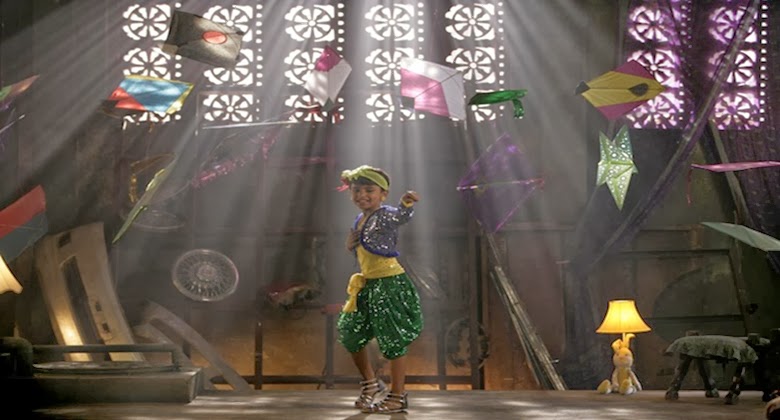
Third in line was a short by Zoya Akhtar, sort of Sofia Coppola of Bollywood. Zoya Akhtar, daughter of legendary writer and lyricist Javed Akhtar who co-wrote milestone movies like Sholay(1975) and Deewaar(1975), made her debut in 2009 with Luck By Chance(2009). She also wrote the screenplay for last year's Talaash(2012). Even though I will not call any of her films as my favourites, I don't think she has made a bad film yet. Her short here is about a boy, Vicky, who wants to be a dancer when he grows up whereas his father wants him to play football, be strong and physical; basically be a typical, good boy. It talks about innocent childhood dreams and fantasies, about parents' need to be one of the pack, be conventional. Akhtar's story tackles a different subject or at least something that should definitely be brought in front for discussion in traditional society like India and I would say she did good enough job with it. But similar to Karan Johar's segment, I had some problems with it despite everything good about it.

First of all, I am not sure why but I didn't feel anything for the kid. It might be because I was that sort of kid Vicky's father wanted him to be but I was rather annoyed by him. Sure his father, played rather brilliantly by Ranvir Shaury, made me feel sorry for him a couple of times but that was sort of pity than anything else. His older sister was someone I would like to see a movie of. As a character she might not be as interesting but that little girl playing her part certainly made it so. And once again, I am not exactly sure how to justify this film celebrating 100 years of Indian cinema. Sure, Vicky gets this whole idea of being a dancer from an item number in Hindi film and he sort of idolizes one Bollywood actress and it is a way of demonstrating how cinema can affect our lives but I guess I was looking for something deeper. Considering all this, I would probably say this to be my least favourite of the four.

Last of the four is directed by Anurag Kashyap. It is very hard to point to one thing as start of his career because this guy has been all over in the last 15-20 years. First thing I remember his name from is as a writer of Satya(1998). However in the last few years by starting producing different films, he has become quite a big deal. He has done handful films as a director as well and one people will probably remember the most is last year's Gangs of Wasseypur(2012). His short is a story of a man whose father is ill and may die soon. His last wish is for his son to meet legendary Bollywood actor Amitabh Bachchan and share a murabba with him. Kashyap, whose films have always been gritty and grim, shows a lot of heart in this film and is probably the funniest of all four. I loved its ending! Not to beat the dead horse again but what I said above about Karan Johar's short, I know can be applied to Kashyap's short here as well. But the difference here is he integrates that fact into the story so well that he probably will have to rewrite the whole story here if he was to change it from meeting Amitabh Bachchan to, say, some great industrialist or a visionary.

While I am on the comparison of the two directors, it is also interesting for me to see the two working together. From mid-90s Bollywood was taken over by what I called above Karan Johar brand of films. In the last few years, it is moving more towards serious, more realistic, more experimental films. I believe Anurag Kashyap has played very important role in it. In other words, it has migrated from Karan Johar school of film-making to Anurag Kashyap school of film-making. And to give credit where it's due, even though two streams could not be more different, Karan Johar has been very supportive of this transition. But for that reason, it is rather interesting for me to see them work in collaboration.

It ends with sort of song and dance sequence that Bollywood is famous for. I haven't exactly sorted out how I feel about it because best thing about this is it brings a lot of big names of the industry together to give tribute to industry itself but I then it also could have been better. I thought it to be rather cheesy and lyrics certainly could have been much better but I guess I can live with it.

Rating(out of 5):

Thursday, July 11, 2013

Che: Part One and Two


I am sure that all of us have heard, read and in case you are a fellow movie blogger, in many cases, even wrote about Steven Soderbergh and his alleged retirement from film making after Side Effects(2013) earlier this year and a HBO movie, Behind the Candelabra(2013). I have seen few of his movies and I really like some of them like Traffic(2000) and Sex, Lies and Videotape(1989). Moreover I really appreciate the way he goes from genre to genre, never confining himself to any particular type of films. However I am also aware that there is a whole lot of his work that I haven’t seen yet. While reading all the retrospective or top 10 posts about him, two films that I had not seen then jumped out to me – Out of Sight(1998) and Che(2008).

Che is a biopic of Earnesto ‘Che’ Guevara, an Argentine by birth who went on to become one of the closest people to Fidel Castro and one of his generals in his fight that eventually deposed the US-backed dictatorship of Fulgencio Batista. It consists of two feature-length films in which Part One talks exclusively about the Cuban revolution starting with the very first time he meets Fidel Castro in Mexico till the climactic battle of the two forces in Santa Clara where two armies go against each other for one last time. Impressed by Castro’s ideology and vision, Guevara joins Castro's 26th of July movement and travels to Cuba with him on a yacht. As a learned man himself with his own ideology and a medical student before joining the revolution, Che quickly finds his footing in the organization and makes himself useful wherever he is needed. Shortly, he begins his steady ascent to become one of the most important and trusted people around Fidel Castro. He also plays a pivotal role in the final battle against Batists's forces in Santa Clara and after that in various roles in Fidel Castro's government

Guevara was an expert in Guerrilla warfare on which he went on to write many books. Various battles that we see throughout this film are a great example of this Guerrilla style, giving whole film some more authenticity. Narration of the film works on two fronts, first the revolution and second, his interview with Lisa Howard in 1964 while he was in US, for addressing the UN.. Their conversations give us a chance to know him better, to give his character more depth. We learn about his personality, his ideology and his work while he held many important positions in Castro’s government. While answering one of her questions, Guevara talks about his idea of a real or ideal revolutionary. He says an ideal revolutionary is the one that never stops, that always keeps on working. He probably thought of himself as one. So after Cuba settled under Castro’s leadership, he thought it was his duty to go and help others who might need it. Part Two concentrates on his efforts to bring about similar revolution in Bolivia.

In 1965, Guevara lands in Bolivia under a false name to help the Bolivian revolutionaries to take over the government. Right from the start, he faces opposition not only from the government but also from his own organization as they don’t want to take the arms and he feels it necessary for any coup to be followed by an armed insurgence if you want to stay in control. Slowly he starts to lose all his resources that made them successful in Cuba and government, once again with CIA help, tightens their grip around him. In comparison to first, Part Two is rather slow, grim and maybe even uneventful. But it also had something that kind of validated the existence of both these films for me.

After watching Part One, most important question I had in my mind was what’s so great about Che Guevara that he warrants a 4+ hour biopic? All I knew about him then was what we see in the film. Of course, there is no rule that decides whether a person is worthy of making a biopic or not. But still, there must be something about him that must have caught Soderbergh’s attention, something that made him important enough to be made a biopic of. In part one; he is one of the most trusted people of Castro, one of the top generals that fought with him from start and even the person who gives him that all important final victory. But when he went to Bolivia, in a spirit of a true revolutionary by his own definition, that act certified him ‘biopic worthy’ to me. Unfortunately, all his efforts elsewhere did not produce the desired efforts anywhere after Cuba but the fact that he left everything behind just to lend his expertise, reflected him in another light to me. Now I wanted to know as much as I can about this guy.

As I said earlier, Out of Sight and Che were two movies from Soderbergh’s line of work that caught my attention and both for different reasons. Out of Sight is a movie that almost everyone I know has praised. People seem to love this movie. On the other hand, Che had a curiously polarizing reaction. People either love it or hate it but what attracted me more towards it was the political background of this movie. After having seen it, I can understand why people might not like this film. It is a long, in many cases slow and over analytical film, especially second one, and if you are not interested in the political side of it, it might bore you. However I went over some of the Netflix reviews for the film and a lot of people seem to think this is an undeserving biopic because Guevara was a communist. I don’t agree with this reasoning, even resent it but I do understand where it comes from. As I tried to learn more and more about this guy, I observed that it is not just film that it’s not just the film that divides people but the man himself. He seems to be as respected, loved as he is hated. Given the kind of life he led, I wouldn’t expect any other outcome.

The only problem I had with the film was the lack of real relatable character other than Guevara. There are hundreds of characters that come and go during the span of two movies but except for Che, none of them left any kind of mark on me. Not even his wife who, before getting married, fights alongside him as his guide in Cuban revolution or even Fidel Castro, played by Damien Bichir, who probably had the second most screen time but has just a fleeting presence. Che, however, was brought brilliantly to life by Benicio Del Toro. It was an absolute delight watching him in that role. From meeting Castro till the end in Bolivia, Guevara goes through a lot during the course of the two movies and majority of credit for making him believable or mildly interesting even in the dullest parts of story goes to his constrained but powerful performance. Apparently Soderbergh spent a lot of time researching before he took this project on and it pays off handsomely as the authenticity of the film can be seen right from the word go. Perfect locations, settings and decision of shooting in Spanish go a long way to help as well. Second part does suffer from pacing issues and could also have benefited from some trimming. However for anyone with any interest in the politics, ideology behind it, this should serve as a great reference.

Rating(out of 5) for both Part I and II:
 
Related Posts Plugin for WordPress, Blogger...